Bike Helmet Size Guide: Measure, Fit, and Adjust Correctly
Getting the right bike helmet size is crucial for both safety and comfort. A properly fitted helmet can prevent serious head injuries during a crash, while an ill-fitting helmet may shift position or fail to provide adequate protection.
This beginner-friendly guide will walk you through measuring your head, selecting the correct size, and adjusting your helmet for the perfect fit.
How to Measure Your Head for a Helmet
Measuring your head circumference is the first step to finding the right helmet size. It’s a simple process that takes just a few minutes and requires minimal tools.
Tools You’ll Need:
- A soft measuring tape or flexible cloth tape measure
- A string and ruler (if you don’t have a measuring tape)
- A pen and paper to record your measurement
Step-by-Step Measurement Guide:
Step-by-step guide for measuring head circumference for proper helmet sizing
- Find the right position: Wrap the measuring tape horizontally around the largest part of your head, approximately one inch above your eyebrows and across the widest part at the back of your head. The tape should pass through the middle of your forehead.
- Keep it level: Make sure the tape measure is level all the way around your head—not tilted up or down. This ensures an accurate measurement.
- Don’t tighten too much: The tape should be snug but not compressed against your skin. It should sit as if a helmet would rest on your head.
- Record both units: Write down your measurement in both centimeters and inches, as different helmet brands use different measurement systems.
- Measure twice: For accuracy, measure twice. If you get slightly different results, use the larger measurement to ensure a secure fit.
Pro Tip: Ask a friend to help with the measurement for the most accurate result, as it can be difficult to keep the tape perfectly level when doing it yourself.
Understanding Helmet Sizes: Quick Reference Chart
Once you have your head measurement, use this chart to find your approximate helmet size. Remember that sizing can vary between brands, so always check the specific manufacturer’s size chart.
| Head Circumference (cm) | Head Circumference (inches) | Adult Size | Youth Size |
|---|---|---|---|
| Below 51 cm | Below 20″ | Extra Small (XS) | Toddler |
| 51-55 cm | 20-21.75″ | Small (S) | Child |
| 55-59 cm | 21.75-23.25″ | Medium (M) | Youth |
| 59-63 cm | 23.25-24.75″ | Large (L) | — |
| Above 63 cm | Above 24.75″ | Extra Large (XL) | — |
Important Note: Brand sizing varies slightly. Always check the specific size chart from the helmet manufacturer before purchasing.
How to Properly Position Your Helmet
Now that you have the right size, positioning is essential for maximum protection and comfort. An incorrectly positioned helmet won’t protect your forehead properly and may obstruct your vision.
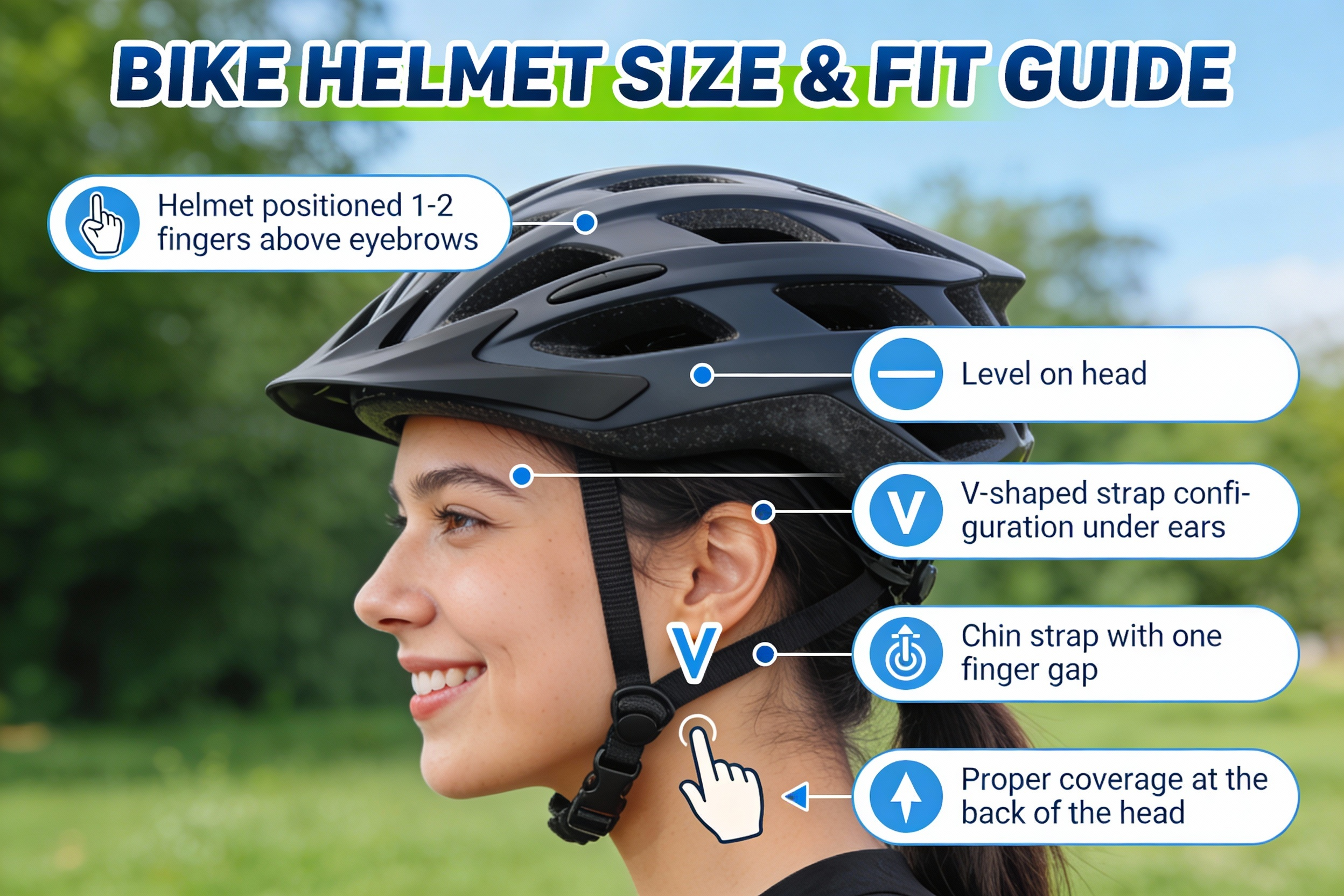
Proper bike helmet positioning showing correct fit and positioning guidelines
Positioning Checklist:
- ✅ Level on your head: The helmet should sit level and straight, not tilted forward or backward
- ✅ Protect your forehead: Position the front edge of the helmet one to two finger-widths above your eyebrows
- ✅ No obstruction: You should be able to see clearly without the helmet blocking your vision
- ✅ Even coverage: The helmet should cover your head evenly with no high or low spots
Adjusting Your Helmet Straps for the Perfect Fit
Proper strap adjustment is critical for keeping your helmet securely in place during a ride. Most helmets have multiple adjustment points that allow you to customize the fit.
The V-Strap Positioning
The side straps should form a “V” shape around your ears, sitting just in front of and below your ear lobes.
How to adjust:
- Loosen both strap dividers if they’re adjustable
- Adjust the sliders on both straps until the straps form a V underneath your ear
- Make sure both sides are even and symmetrical
The Chin Strap Adjustment
The chin strap must be snug but not uncomfortably tight. A properly adjusted chin strap is essential for keeping the helmet in place if you fall.
Correct chin strap fit:
- You should be able to fit exactly one to two fingers between the chin strap and your chin
- The strap should be comfortably snug against your jaw
- When you yawn or open your mouth wide, you should feel the helmet gently pull down on your head
- If you have excess strap, you can tuck it into the rubber strap keeper or carefully trim it
Adjusting the Rear Fit System
Most modern bike helmets have a dial or wheel adjustment system at the back of the helmet that tightens or loosens the internal padding to match your head shape.
Steps to adjust the rear fit system:
- Unbuckle the chin strap for easier access
- Locate the adjustment wheel or dial at the back of the helmet
- Turn clockwise to tighten and counterclockwise to loosen
- Turn slowly until the helmet sits snugly on your head without any gaps
- The padding should fit your head evenly without creating pressure points
- Rebuckle the chin strap when you’re finished
Testing Your Helmet Fit
Before you ride, test your helmet with these simple checks to ensure it’s properly fitted.
The Movement Test
- Side-to-side test: Gently shake your head side to side. The helmet should move with your head without shifting more than an inch
- Forward-backward test: Gently move your head forward and backward. Again, the helmet should move with you without sliding
- The eyebrow test: If the helmet moves more than one inch, tighten it further or try a smaller size
The Skin Movement Test
When you move the helmet, your skin around the eyebrows should move with it. If the skin stays stationary while the helmet moves, the helmet is too large.
The Yawn Test
Open your mouth wide in a big yawn. The helmet should pull down slightly on your head. If it doesn’t, the chin strap isn’t tight enough.
The Comfort Test
Wear the helmet for 15 to 30 minutes before your ride to check for pressure points. Common problem areas include:
- Directly on the forehead
- Above the temples
- At the sides of your head
If you notice any red marks or persistent discomfort after removing the helmet, you may need to try a different size or style, as the padding should break in over time but shouldn’t cause pain.
Helmet Sizing by Age Group
Different age groups require different helmet sizes. Here’s a quick guide:
Kids’ Helmets (Ages 4-10)
- Head circumference: 49-55 cm (19-21.75 inches)
- Typical sizes: Child universal or S (Small)
- Important: Never buy a helmet for your child to “grow into.” Always select a helmet that fits now
Youth Helmets (Ages 8-12)
- Head circumference: 50-57 cm (19.7-22.4 inches)
- Typical sizes: Youth or OSFM (One Size Fits Most)
- Pro tip: Check your child’s helmet fit annually, as padding compresses over time
Adult Helmets
- Small: 51-55 cm (20-21.75 inches)
- Medium: 55-59 cm (21.75-23.25 inches)
- Large: 59-63 cm (23.25-24.75 inches)
- XL: 63+ cm (24.75+ inches)
Quick Fit Adjustment Checklist
Use this checklist to verify your helmet is properly fitted every time you ride:
Before riding, check that:
- ☐ The helmet sits level on your head
- ☐ The front edge is 1-2 finger-widths above your eyebrows
- ☐ The side straps form a V shape under your ears
- ☐ You can fit 1-2 fingers between the chin strap and your chin
- ☐ The helmet doesn’t move more than 1 inch when you shake your head
- ☐ There are no uncomfortable pressure points
- ☐ You have clear forward and side vision
- ☐ The rear fit system is snug but not painfully tight
Common Fitting Problems and Solutions
Even with the right size, you might encounter some fitting issues. Here’s how to solve them:
| Problem | Cause | Solution |
|---|---|---|
| Helmet too loose | Undersized or rear fit system too loose | Tighten the rear dial, try a smaller size |
| Helmet too tight | Oversized or rear fit system too tight | Loosen the rear dial, try a larger size |
| Red mark on forehead | Helmet shape doesn’t match head shape | Try a different brand or helmet model |
| Pressure on temples | Head is too round for the helmet shape | Look for a more rounded helmet style |
| Helmet tilts forward | Rear straps too loose | Tighten rear strap dividers or adjust rear system |
| Helmet tilts backward | Straps too tight or improper positioning | Loosen slightly, reposition on head |
| Chin strap uncomfortable | Too tight or improper adjustment | Loosen slightly until 1-2 fingers fit |
| Helmet blocks vision | Positioned too high | Lower helmet to proper position, readjust straps |
When to Get a New Helmet
While a well-fitted helmet can last years, certain situations require replacement:
- After any significant impact: Even if there’s no visible damage, the inner foam may be compromised
- Age: Replace helmets every 5 years, as materials degrade over time
- Visible damage: Cracks in the shell, torn straps, or loose padding indicate it’s time for a new helmet
- Outgrown: Children’s helmets should be checked annually and replaced as heads grow
Why Proper Helmet Fit Matters
A properly fitted helmet can reduce the risk of serious head injuries and traumatic brain injuries by up to 70%. However, a loose or poorly fitted helmet loses much of its protective benefit. Even small adjustments can make the difference between adequate protection and inadequate protection during a crash.